


Happy almost Thanksgiving! We’ve all seen the Waymos, the Teslas on FSD, and a whole parade of autonomous trucking companies. Those teams are solving a very hard problem: a car has to handle the whole world, from left turns and cyclists to a mattress falling off a pickup. This week I went looking at a much more confined version of the same problem: autonomous railcars. Intuitively, autonomy is a much easier problem when your vehicle can only go forward and backward.
News: On October 7, Parallel Systems closed a $100MM Series C led by AVP, with Hillspire, Agility Global and Cobalt Capital joining. That brings its total raised to a bit over $200MM, and the money goes into producing its third generation Panther vehicle. This week the FRA awarded the City of Columbia, Missouri a $16MM CRISI grant to put 2 Intramotev TugVolt autonomous railcars on a 21 mile Columbia Terminal Railroad. They start with remote switching at the terminal, then will move to autonomous service along the full line, public crossings included, under a phased test program the grant funds over 3 years. And on November 10, Rail Vision said its TrackScout perception system finished testing under the AAR’s Technology Roadmap Program (no results published yet).
Think about the elevator. Nobody calls an elevator an autonomous vehicle, but that’s what it is. It used to have an operator, and it went driverless decades ago, in large part because it only moves in one dimension. A railcar is much closer to an elevator than to a Waymo. It runs on a defined track, usually at low speed, often doing the same haul over and over. It can’t change lanes. Its location is basically a milepost. The perception and decision modeling shrinks to one: is something on the track ahead, and can I stop in time? Also strip off the autonomy and what’s left is a railcar, an infra asset that lasts 40+ years, doing captive, repetitive hauls under long term contracts.
Capital: But while billions have gone into road autonomy, the best funded company in rail autonomy has raised about $200MM. (!!) One would argue it is a regulatory discount, FRA has rules written for each equipment, down to the brake valves and uncoupling levers. So if you come up with new equipment, you need to get a waiver. Others would say the market is niche. Labor savings are smaller and specific to short trains since a train already moves 100+ cars with a crew of 2-3. You are selling to a handful of railroads that are not early adopters. My read is it is one of those innovations falls through the crack between venture and infra funding. Venture gets excited about a trillion dollar TAM, not a BS full of steel, while infra investors love steel and contracted cashflow, but not tech risk and a regulatory path nobody has cleared before. Rail autonomy is too asset heavy for VC and too unproven for infra. Still, as a railroad enthusiast who waited years for Caltrain to electrify, it’s hard to believe a defined FRA path is a bigger hurdle than the open city roads to underwrite.
Tech stack:
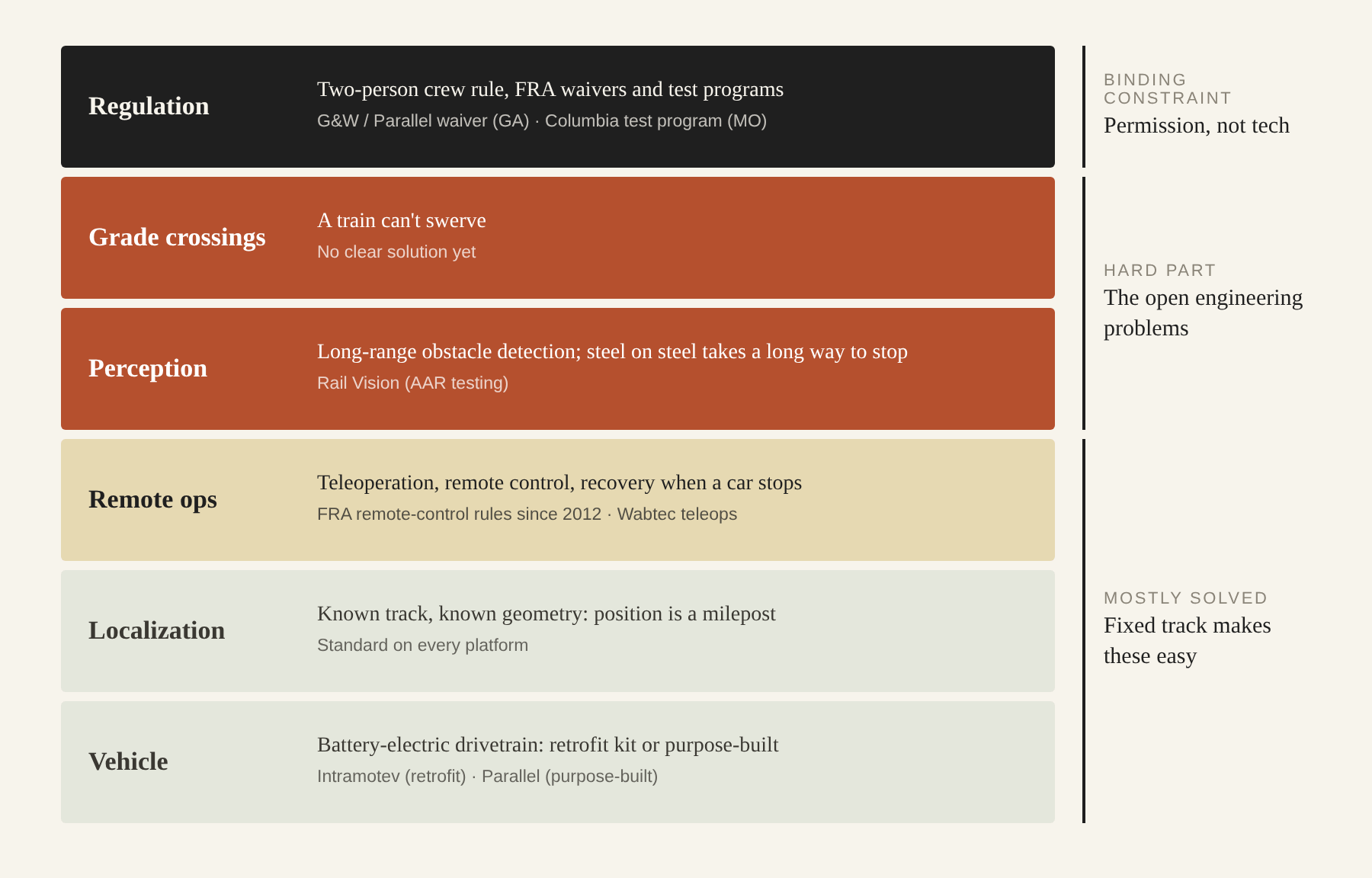
Low speed helps with both. At 15 to 25 mph, stopping distance falls within range of the standard camera + radar stack. That’s why the first commercial miles are switching and short lines, not 70 mph+ mainline.
There are really two different bets in the market right now:
Parallel is going for the big prize. Battery EV carry containers in small platoons and compete with trucks on lanes under 500 miles. Its public partner is Genesee & Wyoming, whose Georgia short lines have tested Parallel’s cars under an FRA waiver granted in early 2025.
Intramotev retrofits existing railcars so they move themselves for switching and short hauls without a locomotive. It started inside mines and plants, then signed R.J. Corman’s 113-mile Memphis Line in March and ÖBB Rail Cargo in Austria in April.
The bigger constraint seems to be labor law. In 2024, FRA finalized a rule requiring at least two crew members on freight trains, an engineer and a conductor. The railroads sued, and in August 2026 a federal appeals court upheld it. If you want to run with <2 crew members you have to prove it’s just as safe, one operation at a time. That’s the path Parallel took: its pilot runs on 22 waivers, over objections from the engineers’ and conductors’ unions. The fight even helped push Georgia Central’s own crews to unionize for the first time. (Elevator operators weren’t thrilled either; FWIW I can imagine the process took long for people to trust stepping in driverless elevators.)
So where should we fund? Aircraft and railcar markets solved this a long time ago. A separate fleet vehicle owns the cars and leases them to operators, and the tech company supplies the autonomy kit and software under a service agreement. The base asset already finances cheaply. Greenbrier priced $300MM of railcar lease ABS in February at a blended 5.2% (!!). Leasing market is solid too. GATX’s North American fleet ran at 98.4% utilization in Q3, with renewal rates up 12.4%, and the industry is on track to scrap about 40,000 cars this year, more than it builds. The return shape is a bond + call: railcar lease yield, plus upside if autonomy lets each car make more turns. The tricky part is the kit. Batteries and sensors depreciate over roughly a decade, not 40 years, and nobody knows yet what a used autonomy kit is worth. I’d put the hull and the kit in separate tranches, and ideally build the hull to interchange standards so it can go back to being an ordinary railcar if autonomy stalls. It’s the same robots-as-an-equipment-lease story we saw with Formic, and in my May construction autonomy piece.
What I like most about this one: a failed autonomous railcar is still a railcar, in a market where railcars are being scrapped faster than they’re built.
PS: If you enjoyed this, share it with a colleague or friend who might too. And if you’re building or financing in this space, I’d love to chat. I’m at meng@fridaymorninglabs.com :)