


One of the most interesting capital deployment in energy right now is finding capacity that already exists: startups using AI and grid simulation to identify latent capacity on existing transmission and distribution networks.
GridCARE’s partnership with National Grid in New York aims to cut interconnection timelines from years to 6-12 months by modeling spare capacity across the grid in real time. Emerald AI, backed by Nvidia, Energy Impact Partners, Eaton, GE Vernova, and the CIA’s venture arm IQT, closed a $25M round (total $68M in 16 months) to build “grid-friendly AI factories” — software that flexes data center load at peak times so facilities can connect faster without costly transmission upgrades. Their thesis: up to 100 GW of latent capacity sits on the existing US grid if loads are managed intelligently. Soma Energy, founded by ex-AWS energy leaders, emerged from stealth with $7M to do something similar — optimize real-time dispatch between power plants and data centers to unlock spare megawatts.
The common thread: the interconnection queue is 2,600 GW deep. Building new generation takes 5-7 years. But software that identifies and dispatches existing spare capacity can deliver power in months. For investors, this is a classic “picks and shovels” category — platform businesses with recurring revenue, utility partnerships, and capital-light models. The risk is execution: utilities are conservative buyers, and proving grid reliability under flexible load management requires years of operating data. But the demand signal is real, and the first movers are attracting serious capital.
Overheard in the Grid Queue
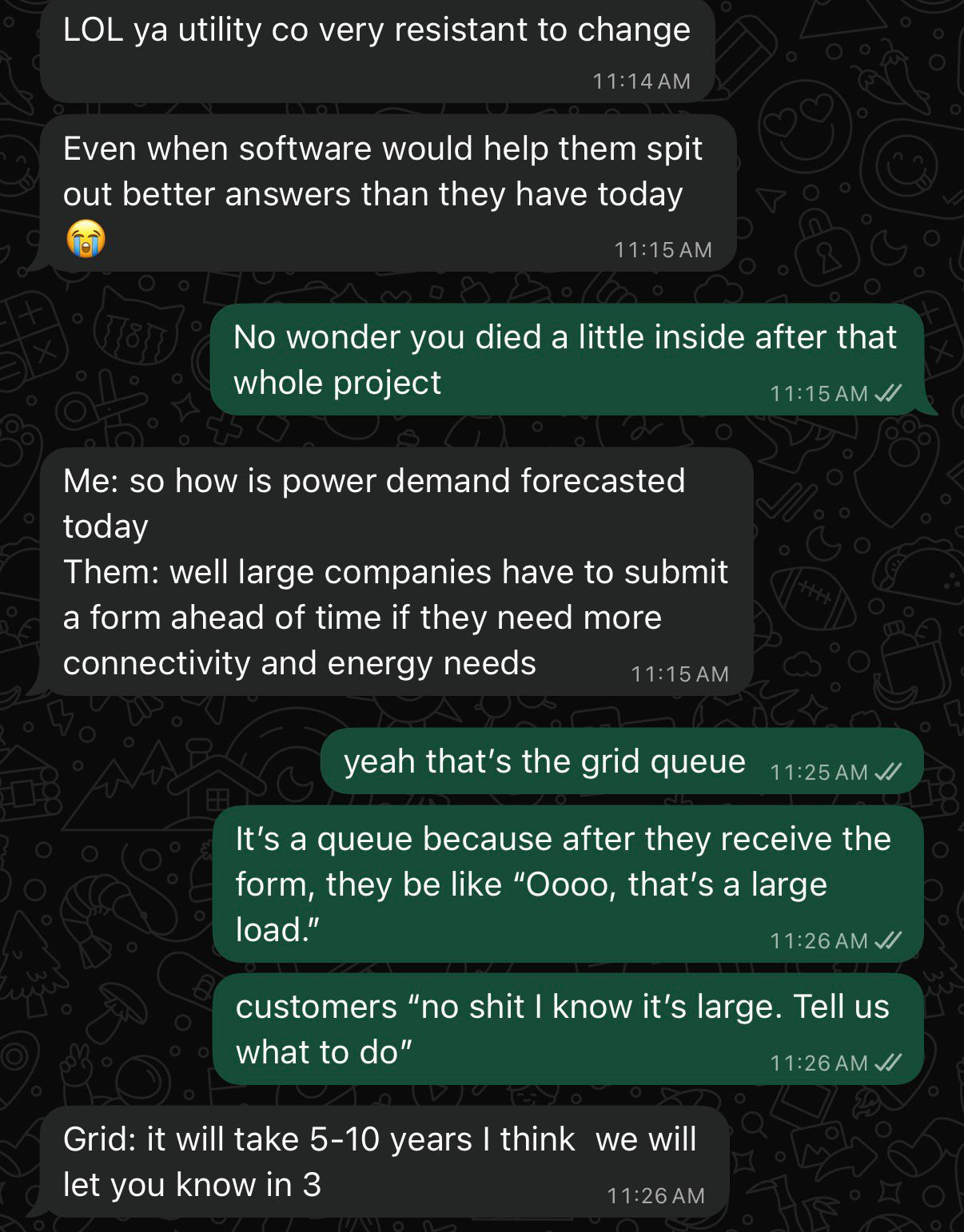
*This is why three startups raised a combined $100M+ this month to fix grid interconnection with software instead of paperwork.*
## Capital Raises & Deals
**Valar Atomics — $450M Series B ($2B Valuation)**
Palmer Luckey-backed nuclear startup raised $340M equity plus $110M debt for high-temperature gas-cooled reactors targeting data center and industrial baseload. Valar achieved nuclear criticality five months ago and is targeting commercial operations by July 2026 at a DOE-partnered Utah site. The debt component is notable — lenders underwriting nuclear development risk, not just equity. If they hit timeline, it resets the market's view of SMR bankability. Worth watching beyond the reactor itself: high-temp gas-cooled designs run at 750–950°C, which demands specialized heat exchangers, advanced materials (SiC composites, nickel superalloys), and thermal storage for load-following — an entire supply chain layer that barely exists as a standalone category today. As SMRs proliferate across different coolant architectures, “thermal management suppliers” could become the next opportunity, cutting across nuclear, data center cooling, and industrial decarb simultaneously.
**EnerVenue — $300M Series B Extension**
Fremont-based nickel-hydrogen battery maker closed $300M led by Full Vision Capital, bringing on new CEO Henning Rath. The technology targets 4-12 hour discharge with 30,000-cycle durability — infrastructure-grade storage with dramatically lower degradation than lithium-ion. New 250 MWh production line starts construction later this year.
**Bloom Energy / AEP — $2.65B Fuel Cell Deployment**
Up to 1 GW of solid oxide fuel cells for data center projects. Combined with Bloom's $5B Brookfield agreement, nearly $8B in total pipeline. Fuel cells are deployable in months, not years — the speed premium is real for data centers stuck in interconnection queues.
---
## Market Moves
**DOE's $1.9B SPARK Transmission Program — Concept Papers Submitted**
Full applications due May 20. SPARK targets reconductoring — replacing existing transmission lines with higher-capacity conductors on the same rights-of-way. Faster and cheaper than new corridors. The program directly funds the supply chain for companies like TS Conductor and CTC Global. Watch for award announcements soon!
**Long-Duration Storage Hits Inflection Point**
Wood Mackenzie reports LDES installations reached 15 GWh in 2025, up nearly 50% YoY, though still only 6% of total storage. The shift: data centers are becoming the anchor customer class. Form Energy's 12 GWh iron-air deal with Crusoe (deliveries starting 2027), plus a separate Google data center battery in Minnesota, represent the largest committed LDES pipeline ever. Eos Energy says data centers are now nearly 25% of its project pipeline, up from negligible a year ago.
---
## Across the Capital Stack
**Venture: Grid Intelligence May Finally See ARR**
Three funded startups in one month — GridCARE (National Grid partnership), Emerald AI ($68M total), Soma Energy ($7M seed) — all attacking the same problem: finding and dispatching spare grid capacity using AI. The business model is SaaS + utility partnerships, not capital-intensive buildout. For VCs, this is a familiar software playbook applied to a $500B infrastructure bottleneck.
**Project Finance: LDES Graduates from Pilot to Pipeline**
The driver behind long-duration storage's moment: 1) data centers need 24/7 firm power but can't wait for grid connections, 2) regulations in some states now allow industrial loads to proceed with self-supplied backup, 3) lithium-ion can't economically serve 8-100 hour durations. Form Energy's $20/kWh target at 100-hour discharge fundamentally changes the math. EnerVenue's 30,000-cycle nickel-hydrogen adds another bankable chemistry. As offtakes formalize, expect project finance structures to follow.
**Credit: Fuel Cells as Bridge Infrastructure**
Bloom Energy's $8B combined pipeline (AEP + Brookfield) is essentially long-dated power purchase agreements backed by utility-grade counterparties. For infrastructure debt funds, these are contracted cash flows with known technology risk. The investable angle: fuel cells fill the 2-5 year gap before grid connections or nuclear come online.
---
## Seed/A Watchlist
**Astro (YC W26) — Grid Interconnection Intelligence**
Founded by Alex Fuster, former Citadel energy trader. AI models identify profitable grid connections that eliminate the surprise costs causing 80-90% of renewable projects to fail. Addresses the same interconnection bottleneck from the developer side rather than the utility side.
---
## Sources
Fortune, Utility Dive, C&EN (American Chemical Society), Axios Pro, GeekWire, Bloomberg, Energy Storage News, TechCrunch, Crunchbase, Wood Mackenzie, DOE.gov, Y Combinator, Latitude Media